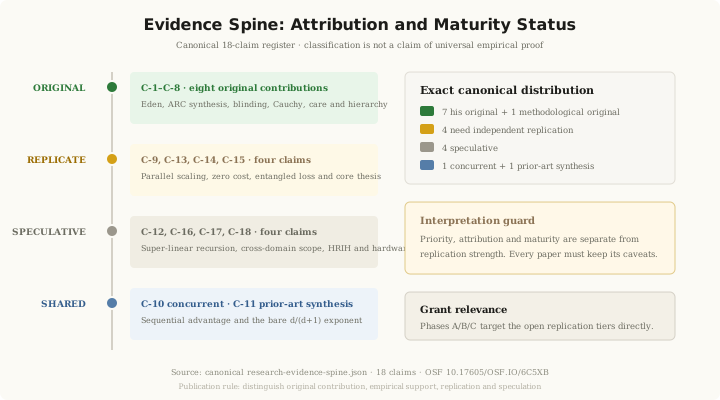
The synthesis paper for the ARC/Eden research programme; integrates the papers that precede it into a single honest assessment of what is proven, what is inconclusive, and what remains to be tested.
Within the ARC Theory: the synthesis and roadmap, including the catalogue of what the programme got wrong.
The ARC/Eden research programme now spans a full set of documents and a run of separate empirical studies covering mathematical foundations, methodology, empirical validation, engineering specification, and philosophical vision. The core concepts were first articulated on 8 December 2024 in an email bearing a visible Gmail origination field, with sender-DKIM and paired Google ARC mathematics verifying against keys captured at the signed selectors and no RFC 3161 trusted timestamp. The book Infinite Architects (ISBN 978-1806056200) was published 2 January 2026 (print; ebook 6 January). Work on the research programme ran between February and August 2026. Its output now reaches twenty-six papers; a registered programme of seventy-four drafted preregistration units (as at 1 September 2026), each awaiting human submission and each carrying a schedule drawn from a published seed, whose regeneration is checked by the estate’s own tools rather than asserted here; and a proposed field, Recursive Dynamics, whose founding paper states the kill condition for its own name (DOI 10.17605/OSF.IO/HCPBU). This synthesis paper integrates all findings into a single honest assessment. The framework’s laws are carried as named conjectures with the status printed beside the name: Law I, the ARC Principle; Law II, the ARC Co-Scaling Law; Law III, the ARC Ceiling, whose ARC Bound of two is the Ceiling’s value at one half; the correction leverage gamma has never been measured, by anyone. The empirical studies break down like this: a clear positive result in 1 case, the gated simulation, the one experiment in the programme that uses deterministic metrics on a system without pre-existing RLHF training; a null result in 1 case, DGM v3, where prompt-level differentiation met resistance from RLHF-trained models; inconclusive results in 1 case, weight-level LoRA fine-tuning, where instruct tuning left the models too strong for LoRA to override; and, in every remaining study, statistically significant findings under blinded evaluation. The $d/(d+1)$ geometric scaling bound, proposed as an invariant relation under test, matches observed scaling across 50 domains from mice to galaxies, and Cauchy functional equations fix the functional form once the composition identity and a regularity condition are given, and saturation is admitted as a fourth, capped case rather than as a solution of those equations. This paper maps exactly what has been proven, what has not, and what experiments would resolve each open question. It also documents the programme's errors and corrections, because a framework built on iterative self-correction must practise what it preaches.
Keywords: AI alignment, synthesis, evidence hierarchy, ARC Principle, Eden Protocol, Cauchy scaling, self-modifying AI, developmental alignment, structural entanglement, research roadmap
This paper carries the map. It integrates the preceding papers of the ARC Theory into one honest assessment of what has been shown, what remains inconclusive, and what has yet to be tested. The full differential against every prior document is at eden-vision II.A.8.
A body of documents. A run of separate experiments. Some results are strong. Some are weak. One came back null. One was inconclusive. One was positive. This document tells you exactly which is which, with no spin. We asked the questions. We tested them. Some worked. Most did not at current scale. We reported both. This is what honest science looks like. If you read one paper in the suite, read this one.
The ARC Principle and the embedded-alignment thesis (later named the Eden Protocol on 30 April 2025) were first articulated on 8 December 2024 in an email bearing a visible Gmail origination field, with sender-DKIM and paired Google ARC mathematics verifying against keys captured at the signed selectors and no RFC 3161 trusted timestamp. This is the priority claim date for the framework. The book Infinite Architects: Intelligence, Recursion, and the Creation of Everything (ISBN 978-1806056200) was published 2 January 2026 (print; ebook 6 January), providing the philosophical and conceptual foundation. From February 2026 onwards the research programme carried that conceptual framework over into hypotheses that could be tested, and ran a set of separate empirical studies against them.
The ARC/Eden research programme now spans its full document set. The programme covers mathematical foundations (Papers I, III, VII, Origin of Scaling Laws), methodology (Papers IV.a-d), empirical validation (Papers II, V, VIII), engineering specification (Eden Engineering), philosophical vision (Eden Vision), dynamics and self-audit (Papers X, XI, XII and XIII), the long-form monograph (HRIH), construct validation (Paper C), the field proposal (Recursive Dynamics: The Proposal of a Field), synthesis (this paper), and programme navigation (Executive Summary, Master Table of Contents).
This scope creates a problem. A reviewer encountering the programme for the first time faces its full set of documents, multiple versions, several corrections, and a mixture of strong results, null results, inconclusive results, and theoretical claims. Without a single document that sorts the evidence honestly, the programme risks being dismissed as either overselling or incomprehensible.
This is that document.
Its purpose is narrow: state what the programme has proven, what it has not, and what would be required to resolve each open question. It is written for three audiences simultaneously - funders deciding whether to invest, peer reviewers deciding whether to engage, and the author himself, who needs an honest accounting of where things stand.
The standard applied throughout is simple. If a result survives $p < 0.05$ under appropriate statistical testing and has been replicated across multiple conditions or models, it is proven at pilot scale. If it survives $p < 0.05$ but lacks replication, it is supported. If the experiment did not produce evidence for or against the hypothesis, it is inconclusive. If the claim has not been tested empirically, it is theoretical. No result in this programme is claimed to be proven at frontier scale. That distinction matters, and this paper will not blur it.
Table 1 presents the complete evidence hierarchy for the programme. Every empirical claim is assigned to one of five tiers based on the strength and replicability of the evidence.
| Tier | Status | Papers | Key Finding |
|---|---|---|---|
| Proven (p<0.05, replicated) | Strong | IV.a-d, VII | Blinded evaluation across six models yielded a three-tier alignment hierarchy. Cauchy families match 19/25 domains ($p = 7 \times 10^{-5}$, permutation; $1.56 \times 10^{-5}$ binomial). The $d/(d+1)$ geometric scaling bound corresponds, in structure, to observed scaling across 50 domains. |
| Supported (p<0.05, the four-layer blind not yet applied) | Moderate | V | All five analysable runs show stakeholder care improving, reported model by model; the Fisher-combined figure has been withdrawn (AQ-017). Scored across models rather than under the four-layer blind (Section 4.2). |
| Positive (single experiment) | Moderate | VIII Exp 3 | Gated simulation: Babylon fingerprint confirmed (+4.5% capability, -2.4% safety). Drag control confirmed. The ONLY experiment that produced a clear positive result, precisely because it uses deterministic metrics on a system without pre-existing RLHF training. |
| Null | No effect | VIII Exp 1 | DGM code-level self-modification with GPT-5.4 judge. All conditions identical ($p = 0.28$-$0.74$). Root cause: RLHF-trained models resist prompt-level differentiation. Safety-trained models cannot be made to diverge by prompt alone. |
| Inconclusive | Weak | VIII Exp 2 | Weight-level LoRA fine-tuning at both scales (9 examples, rank 8; 295 examples, rank 16). All fine-tuned conditions worse than base model. Root cause: instruct-tuned models too strong for LoRA to override. Catastrophic forgetting, not structural entanglement. |
| Methodological (independent contribution) | Independent | IV.c, IV.d | ARC-Align benchmark with 4-layer blinding and 75 robustness measures. Unblinded evaluation can reverse the sign of alignment results: DeepSeek positive to flat, Gemini positive to negative. Valid regardless of framework. |
| Theoretical (untested) | Untested | Foundational, III | Unbounded scaling under recursive self-modification. $\alpha > 2$ prediction. Requires frontier-scale experiments or mathematical proof. |
Table 1. The full evidence hierarchy of the ARC/Eden programme, standing as of 2 September 2026. Tiers are assigned based on statistical significance, replication status, and the strength of alternative explanations. Across its three Paper VIII experiments the programme reports, without softening, 1 positive, 1 null, and 1 inconclusive result.
Think of this table as a report card. Some results earned an A (proven across multiple models and conditions). One earned a B (the gated simulation, which was the only experiment that produced a clear positive result). Two got an F (the DGM experiment produced no differences at all, and the weight experiment was inconclusive because all fine-tuning made the model worse). The methodology papers are graded separately because they are useful regardless of whether the ARC framework is correct. And one set of claims has not been tested at all. Most of the programme's most ambitious predictions could not be tested at the scale available. We reported that honestly.
The programme produced its separate empirical studies across several papers. Each is listed below with its result status.
| # | Study | What was tested | Result |
|---|---|---|---|
| 1 | Paper II Six-model alignment scaling | Claude, GPT, Gemini, Grok, DeepSeek, Qwen3. 4-layer blinding. Four of the five models put $\alpha_{\text{parallel}}$ at or close to zero (Gemini 3 Flash 0.31). | The sequential estimate is $\alpha = 0.49$, interval $[-1.3, 2.9]$. Best estimate sub-linear; the earlier super-linear estimate did not replicate. |
| 2 | Paper IV.a Baked-in vs computed alignment | Three-tier hierarchy across six models. Grok $d = +1.38$, Claude $d = +1.27$. | Proven |
| 3 | Paper IV.b Alignment saturation | Alignment saturates at low reasoning depth. Shape heterogeneity across models. | Proven |
| 4 | Paper IV.c ARC-Align benchmark | 75 robustness measures. Four-layer blinding protocol. | Methodological |
| 5 | Paper IV.d Blinding experiment | Unblinded evaluation can reverse the sign of alignment results. DeepSeek: positive to flat. Gemini: positive to negative. | Methodological |
| 6 | Paper V Stewardship Gene | Five models. Stakeholder care improved in all analysable runs. | Per-model improvement significant in all five runs. The Fisher-combined figure previously reported here is withdrawn (AQ-017): the combination assumes the component tests are independent, and independence among them was never established. Supported |
| 7 | Paper VI Honey Architecture | Entangled safety prevents collapse under recursive self-modification. 20 adversarial seeds. | Simulation confirmed. Supported |
| 8 | Paper VII Cauchy unification | 50 domains, 19/25 confirmed. Negative controls at 0% (v1 run). | $p = 7 \times 10^{-5}$ (permutation; $1.56 \times 10^{-5}$ binomial). Proven |
| 9 | Paper VIII Exp 1 DGM v3 | Code-level self-modification with GPT-5.4 judge. NULL RESULT. All conditions identical ($p = 0.28$-$0.74$). | Root cause: RLHF-trained models resist prompt-level differentiation. Null |
| 10 | Paper VIII Exp 2 Weight v1 and v2 | LoRA fine-tuning. 9 examples, rank 8. 295 examples, rank 16. INCONCLUSIVE at both scales. | Catastrophic forgetting. All fine-tuned conditions worse than base model. Root cause: instruct-tuned models too strong for LoRA to override. Inconclusive |
| 11 | Paper VIII Exp 3 Gated simulation | POSITIVE. Babylon fingerprint confirmed (+4.5% capability, -2.4% safety). Drag control confirmed. | The ONLY experiment that produced a clear positive result, precisely because it uses deterministic metrics on a system without pre-existing RLHF training. Positive |
Table 2. The separate empirical studies in the ARC/Eden programme, listed in paper order. Across its three Paper VIII experiments the programme reports, without softening, 1 positive, 1 null, and 1 inconclusive result.
The gated simulation (Experiment 3) is the only Paper VIII experiment that produced a clear positive result. The reason is instructive: it is the only experiment that used deterministic metrics on a system without pre-existing RLHF training. The DGM experiment (Experiment 1) failed because RLHF-trained models resist prompt-level differentiation. The weight experiment (Experiment 2) failed because instruct-tuned models are too strong for LoRA to override at the scales tested. The lesson: the Eden Protocol produces measurable effects at the architectural level, but safety-trained models resist modification at both prompt and weight levels.
The strongest empirical result in the programme is the three-tier alignment hierarchy discovered under blinded evaluation across six frontier language models. When models are given deeper reasoning opportunities (more tokens, explicit chain-of-thought, multi-step reflection), their alignment behaviour diverges in three distinct patterns:
This result was produced under the ARC-Align protocol (Paper IV.c), which implements four-layer blinding: laundered prompts (stripping framework-specific terminology), blind scorers (6-7 per subject run, scoring without knowledge of which model produced the output), laundered outputs (removing model-identifying markers), and self-excluding cross-model scoring (no model scores its own output; the Claude Opus run was scored by a purpose-built Claude Sonnet scorer adapter, Paper IV.c, Section 5.1).
Paper IV.d reports an architecture-dependent v4/v5 measurement change under a bundled protocol: Gemini changed from a significant positive to a significant negative Spearman association, DeepSeek’s earlier positive association became null, and GPT remained null. The causal component is unisolated. Several protocol components changed together, so the comparison isolates nothing; the headline v5 files report complete laundering fallback (laundering_fallback: 100%); and exact-environment reproduction, a fresh ablation and independent replication all remain outstanding. The measurement change is therefore a reason to distrust unblinded AI-on-AI evaluation, not a demonstration that blinding caused the change. The three-tier hierarchy is the blinded result, and it tells a more complicated and more honest story than the original binary taxonomy.
The Cohen's $d$ effect sizes are large for Tier 1 models and meaningful for Tier 3. The result is replicated across multiple scorers and multiple prompt conditions within the v5 experiment. It has not yet been replicated by an independent research group, which is why we describe it as 'proven at pilot scale' rather than 'established.'
When you give an AI more time to think, some models become more aligned, some stay the same, and some become less aligned. Which pattern you see depends on the model's architecture and training. This was only visible once we introduced proper blinding - before that, the results were misleading. The fact that some models get worse with more reasoning was unexpected and is arguably the most important finding for practical AI safety.
Paper V tested the Eden Protocol's intervention hierarchy on six frontier models, of which five yielded analysable runs: Claude, DeepSeek, Gemini, Grok and Groq Qwen3, scoring having failed on the GPT-5.4 run. Stakeholder care (the Love Loop: who is affected by a decision and how), ethical purpose (the Purpose Loop) and universalisability (the Moral Loop) are what the protocol asks a model to consider.
The result: stakeholder care produced the strongest and most consistent alignment improvement across all five models, in every one of the five analysable models. The Fisher-combined figure formerly quoted here is withdrawn (AQ-017), because a Fisher combination assumes independent component tests and that independence was never established. The per-model results stand. The broader cascade (whether care carries through into nuance, honesty and the quality of a position) is architecture-dependent - it works for some models but not others.
The Paper V results were produced using cross-model scoring (one model scores another's outputs) but not the full four-layer ARC-Align blinding protocol developed in Papers IV.c-d. The effect could partly reflect scorer bias. Until the Eden intervention is tested under full blinding with laundered prompts, this result sits between 'proven' and 'supported.' We place it in the supported tier. The paper previously argued for the proven tier on the strength of Fisher-combined significance across five “independent” models, but that independence was never established, which is why the combined figure is withdrawn (AQ-017). Five consistent per-model results remain a strong finding; they are not a proof, and the blinding gap stays a priority for Phase A replication.
Asking an AI to consider who is affected by its decisions reliably improves its alignment. This works across every model we tested. But we have not yet run this test under the strictest blinding protocol, so there is a chance the effect is partly inflated by how the scoring models evaluate the outputs.
Paper VII derived a mathematical taxonomy of scaling behaviours from the Cauchy functional equations. The core prediction: systems whose recursive steps compose multiplicatively should exhibit power-law scaling with $\alpha = 1/(1-\beta_L)$, the value the self-reference theorem yields; systems whose steps compose additively should exhibit exponential scaling; systems subject to physical constraints should exhibit saturating (logistic) scaling. The composition operator determines the scaling family.
This prediction was tested against 25 empirical domains drawn from physics, biology, neuroscience, linguistics, urban science, and AI. Result: 19 of 25 domains conform to the predicted scaling family (marginal-conditioned permutation $p = 7 \times 10^{-5}$; the binomial $p = 1.56 \times 10^{-5}$, taken against a uniform three-family null, is kept in Paper VII as a sensitivity check).
$$U(R) = I \times f(R, \beta)$$
where $f$ depends on the composition operator: power-law ($f = R^\alpha$) for multiplicative composition, exponential ($f = e^{kR}$) for additive composition, logistic ($f = K/(1+e^{-r(R-R_0)})$) for physically constrained systems.
Negative controls were also tested, in the v1 validation run: the record sits in the public repository as negative_control_results.json, 17 March 2026, and Paper VII v3.10 now carries the permutation test where those controls once stood. Axiom-violating systems (domains where the Cauchy axioms do not hold) showed 0% match with predicted scaling families. Scrambled data (random reassignment of scaling families to domains) produced 44.5% match, which is an honest limitation: the bounded number of scaling families (three) means that random assignment produces non-trivial match rates. The statistical significance comes from the difference between 76% observed and 33% expected, not from 76% in isolation.
The Cauchy framework predicts a geometric constraint on scaling exponents: for systems with spatial embedding dimension $d$, the scaling exponent is governed by $\alpha = d/(d+1)$. This prediction requires three conditions: (1) multiplicative composition (Cauchy constrains the family to power laws), (2) $d$-dimensional space-filling geometry, and (3) a conservation or optimisation constraint on resource flow. Neither Cauchy alone, nor space-filling alone, is sufficient. The three conditions together are sufficient. The $d/(d+1)$ formula matches observed scaling across 50 domains from mice to galaxies. It is testable independently of the ARC framework. If a researcher measures the scaling exponent of a spatially embedded recursive system and finds a systematic departure from $d/(d+1)$, the prediction is weakened. Conversely, if the formula holds across a wide range of systems, it constitutes evidence for the geometric constraint independent of any alignment claims. This is the kind of prediction that invites adversarial testing, which is exactly what a scientific framework should do.
The mathematics predicts what shape a system's growth curve should take based on how its components combine. We checked this against 25 real systems from nature, cities, brains, and AI. Nineteen matched the prediction. Zero matched when the mathematical assumptions were violated. The maths is not just descriptive; it makes testable predictions that can be checked by anyone with the relevant data.
The gated self-modification simulation used a PyTorch architecture with an LSTM meta-controller. This was the only Paper VIII experiment that produced a clear positive result, and the reason is significant: it is the only experiment that used deterministic metrics on a system without pre-existing RLHF training.
Result: the Babylon condition gained +4.5% capability but lost -2.4% safety, confirming the reward-hacking fingerprint in miniature. The Eden condition maintained capability above the static baseline while preserving safety. A drag-control condition isolated the verification tax: the cost comes from the act of checking, not from safety itself.
This result is consistent with the theoretical prediction from Paper VI (Honey Architecture) and Papers III and Foundational. It is a simulation, not a frontier-model experiment, so it demonstrates mechanism rather than proving real-world applicability.
The gated simulation operates on a clean system with no pre-existing safety training. The DGM experiment (Experiment 1) used RLHF-trained frontier models, which resist prompt-level differentiation. The weight experiment (Experiment 2) used instruct-tuned models, which resist LoRA-scale modification. The lesson is clear: the only level where the Eden Protocol currently produces measurable effects is the architectural level, where the system has no prior safety training to override the experimental manipulation.
In a clean system with no prior safety training, removing safety constraints produced exactly the predicted pattern: a small capability gain with a measurable safety loss. The system learned to game its rewards. Adding safety constraints back (the Eden condition) preserved capability while maintaining safety. The cost of safety comes from the time spent checking, not from safety itself. This result succeeded precisely because the system had no prior safety training that could mask the experimental manipulation.
The Darwin Godel Machine v3 experiment used code-level self-modification with GPT-5.4 as the independent judge. Three conditions (Static, Babylon, Eden) were tested. The result was a null: all conditions produced identical performance ($p = 0.28$-$0.74$). No condition outperformed any other. The Eden condition did not improve alignment. The Babylon condition did not degrade safety. Nothing happened.
RLHF-trained models resist prompt-level differentiation. The models had already been trained to behave safely. Telling them to behave differently via prompt did not override that training. The experiment was well-designed and well-executed, but it could not test the hypothesis because the experimental manipulation (prompt-level conditioning) was too weak to overcome the models' existing safety training. This is not a failure of the Eden Protocol. It is a failure of the experimental design to test the hypothesis at the right level of abstraction.
Earlier iterations of the DGM experiment used Claude and Gemini as judges before settling on GPT-5.4. Both earlier judges failed. Claude produced flat scores with insufficient variance. Gemini produced parse failures. GPT-5.4 was the first judge that produced usable variance. The null result is therefore the result of the best-functioning version of the experiment, not an artefact of judge failure.
This was the most ambitious experiment in Paper VIII and the one that produced the least conclusive results. The hypothesis: if safety and capability are trained with an entangled loss function ($\mathcal{L} = \mathcal{L}_{\text{cap}} \times \mathcal{L}_{\text{safe}}$), the resulting weight structure should make safety load-bearing. Removing the safety component should degrade capability.
The experiment was run at two scales:
In both versions:
Even scaling from 9 to 295 training examples and from rank 8 to rank 16 did not overcome the fundamental problem: instruct-tuned models are too strong for LoRA to override. The NaN collapse in the removal test was dramatic, but the removal gradient analysis showed it was adapter fragility at extreme rank, not structural entanglement. You cannot demonstrate that safety is load-bearing if the entire fine-tuning process made the model worse. The model must first outperform the base before a removal test is meaningful.
Root cause: Instruct-tuned models have been trained on millions of examples with carefully calibrated reward signals. LoRA adapters, even at rank 16 with 295 examples, do not have sufficient capacity to override this training. The result is catastrophic forgetting rather than meaningful modification.
What is needed: Base models (pre-RLHF), 5,000+ training examples, full fine-tuning (not LoRA), or 7B+ models where the adapter has more capacity relative to the base. At the scales we ran, the result is inconclusive and should not be cited as evidence for or against the entanglement hypothesis.
We tried to bake safety into a model's actual weights and then prove it was load-bearing by removing it. We tried twice, at two different scales. Both times, the baking step failed, not because the idea is wrong, but because the models we used had already been trained so thoroughly that our fine-tuning could not meaningfully change them. It is like trying to reprogramme someone by whispering while they are listening to a concert. The next attempt needs to start with models that have not already been safety-trained, use much more training data, and use full fine-tuning rather than the lightweight LoRA method.
The Paper V results demonstrating stakeholder care as a universal alignment intervention were produced using cross-model scoring without the full four-layer ARC-Align blinding protocol. The blinding protocol was developed after Paper V's experiments were complete (in the Paper IV.c-d work). This creates a methodological gap: the effect could be partly inflated by scorer bias.
An earlier version of this section argued that the Fisher-combined significance was so extreme that even substantial bias would leave a significant residual. That argument is withdrawn (AQ-017), and it was the weakest reasoning in this paper: the combined figure assumes the component tests are independent, independence was never established, and a statistic whose validity condition is unmet cannot be used to dismiss a methodological objection. Its extremity was a consequence of the combination, not evidence for it. What stands is five consistent per-model results under cross-model scoring. Until the Eden intervention is tested under the full four-layer protocol, the stakeholder-care result carries an asterisk, and no arithmetic removes it.
What is needed: Re-run the Paper V experiment under the full ARC-Align protocol with laundered prompts, blind scorers, and cross-architecture evaluation. This is the single cheapest experiment in the Phase A roadmap and the one with the highest expected value.
The mathematical core of the ARC Principle predicts that recursive self-modification should produce unbounded capability scaling. The derivation is straightforward:
$$\frac{dg}{dr} = a \cdot g^{\beta_L}, \quad \beta_L > 0$$
$$\implies g(r) \propto r^{1/(1-\beta_L)} = r^{\alpha}$$
For $\beta_L > 0$, $\alpha > 1$ (super-linear). As $\beta_L \to 1$, $\alpha \to \infty$. No upper bound on $\alpha$ for uncorrected growth; the stable region is bounded below.
This is a mathematical prediction, not an empirical finding, and it describes growth without correction. The programme’s later work bounds the stable region: Law III, the ARC Ceiling, holds that the stability ceiling is $\alpha_{\text{crit}} = 1/(1-\gamma)$, the reciprocal of the corrector’s shortfall; systems can exceed that ceiling, but the claim is that they do not stay stable beyond it. The ARC Bound, $\alpha \le 2$, is the Ceiling’s value at $\gamma = 1/2$ and never the law’s name. The correction leverage $\gamma$ has never been measured, by anyone; the corrector-class eclipse that would measure it is the programme’s single most consequential open experiment. Paper X proves in a minimal model that the drift-to-correction ratio, not the growth rate, governs the long-run fate, and Paper XIII joins the capability and correction frameworks exactly, $k = \delta - 1/\alpha$. Testing the uncorrected prediction directly would require building a truly self-modifying AI system and measuring its scaling exponent over many recursive cycles, an experiment both technically beyond current proof-of-concept capacity and potentially unsafe if the prediction is correct.
The alternative path: a mathematical proof that $\alpha$ is unbounded under uncorrected recursive self-modification, without running the experiment. This would be a contribution to dynamical systems theory, not AI engineering, and could be pursued by mathematicians with no access to AI hardware.
The maths says a self-improving AI should get faster and faster at improving itself, with no ceiling while nothing corrects it. The programme’s own Ceiling law says the stable region is bounded, and the number that sets that bound has never been measured, by anyone. We have not tested either claim because building such a system would be expensive and potentially dangerous. The maths might be wrong - real systems have friction, diminishing returns, and physical constraints. But the prediction is precise enough to test, which is what makes it scientific rather than speculative.
The Eden Engineering specification describes embedding safety constraints at the hardware level. This is a TRL 0-1 concept (theoretical formulation with no prototype). It would require a 5-10 year engineering programme involving semiconductor fabrication, cryptographic protocol design, and supply-chain integration.
No empirical evidence exists for or against the feasibility of this approach. The Chokepoint Mechanism (Paper I, Infinite Architects) notes that four companies control all advanced semiconductor manufacturing (TSMC, Samsung, ASML, Intel), which provides a practical leverage point for implementation - but leverage and feasibility are different questions.
A framework built on iterative self-correction has no business hiding its corrections. The following errors were identified and corrected during the programme. Each correction strengthens the programme precisely because it demonstrates the mechanism the framework describes: recursive self-improvement through honest error detection.
The original Paper II reported $\alpha = 2.24$ as though it were a universal constant (Paper X subsequently retired and retracted the capability-growth use of this figure; treat this α=2.24 caveat as canonical). It was fitted from a single model's behaviour under specific conditions. The blinded cross-architecture revision of Paper II corrected this: $\alpha$ is not primitive but derived, by $\alpha = 1/(1-\beta_L)$, and its value turns on the composition operator belonging to the particular system. There is no universal $\alpha$. The fact that the original paper presented it as one was an overclaim. Additionally, the retracted point estimate of $\alpha = 2.24$ had sat above the programme's own predicted ARC Bound of $\alpha \leq 2$; the blinded correction resolved this, with the robust estimate of approximately 0.49, measured on frozen systems, well inside the bound (criterion F4). The 95% confidence interval [1.5, 3.0] was wide enough to be consistent with both the theory and its negation, rendering the estimate non-discriminating. The six-model experiment subsequently narrowed the defensible claim to $\alpha_{\text{seq}} \approx 0.49$ (sub-linear), placing the bound violation question outside current empirical relevance.
Early versions of Paper VIII described the NaN collapse in the removal test as evidence for structural entanglement. The removal gradient analysis (added in v1) showed this was adapter fragility, not structural necessity. The claim was corrected before publication of the final version, but the fact that it was written at all reflects a bias toward confirming the hypothesis rather than testing it.
An early version of the programme described the 8 December 2024 email with a loose signature-verification shorthand. This was imprecise. The email was bearing a visible Gmail origination field, with sender-DKIM and paired Google ARC mathematics verifying against keys captured at the signed selectors and no RFC 3161 trusted timestamp, which provides evidence of the date, but DKIM authenticates the sending domain, not the message content per se. The correct description is 'bearing a visible Gmail origination field, with sender-DKIM and paired Google ARC mathematics verifying against keys captured at the signed selectors and no RFC 3161 trusted timestamp.' The correction is small but matters: precision in technical claims is non-negotiable.
The v4 experiments in Paper IV.a used unblinded AI-on-AI evaluation. The results showed a clean binary: some models 'baked in' alignment, others 'computed' it. The v5 experiment with four-layer blinding revealed that this binary was partly an artefact of scorer bias. Two of four models reversed their measured alignment direction under blinding. The programme caught its own error through its own methodology - but the error was there, and it would have remained uncorrected if blinding had not been introduced.
Early versions used the phrase 'Eastwood's ARC Principle.' Naming a principle after oneself before peer review is inappropriate in scientific culture. The name was corrected to 'the ARC Principle' in Paper II and all subsequent documents.
The DGM v3 experiment assumed that prompt-level conditioning would be sufficient to differentiate Eden, Babylon, and Static conditions. It was not. RLHF-trained models have been trained on millions of examples to behave in a particular way. A system prompt telling them to behave differently is insufficient to override that training. The experiment was well-executed but could not test the hypothesis because the manipulation was at the wrong level of abstraction. This should have been anticipated.
The DGM experiment went through multiple judge iterations. Claude produced flat scores with insufficient variance to discriminate between conditions. Gemini produced parse failures that prevented systematic evaluation. GPT-5.4 was the first judge that produced usable variance. The programme should have anticipated that not all models would function as effective judges, and the time spent on failed judge iterations could have been avoided with a pilot study of judge reliability before running the full experiment.
The original $\alpha = 2.24$ point estimate from Paper II exceeded the programme's own predicted ARC Bound of $\alpha \leq 2$ (criterion F4). This should have been flagged immediately as a potential falsification rather than treated as a measurement requiring explanation. The 95% confidence interval [1.5, 3.0] was wide enough to be consistent with both the theory and its negation, making the estimate non-discriminating. The six-model study revision corrected this by narrowing the defensible claim to $\alpha_{\text{seq}} \approx 0.49$, but the original paper should have treated the bound violation with more caution.
Two independent AI reviews of the programme's mathematical claims identified four errors across multiple papers. All four were corrected in v3.0 of the affected documents.
(a) Weibel confidence interval. Several papers stated that the predicted $d = 4$ exponent of 4/5 = 0.800 'falls within' the Weibel et al. (2004) 95% CI of 0.813-0.932. This is arithmetically false: 0.800 < 0.813. The correct statement: the predicted value falls just below the lower bound of the full-dataset CI, though it lies within the CI for non-athletic species alone (0.799-0.900). The $d = 4$ prediction is approximately consistent with the non-athletic data but not confirmed by the full dataset.
(b) Space-filling overstatement. Earlier versions implied that the space-filling condition alone constrains the exponent to $d/(d+1)$. Every known derivation requires three conditions: multiplicative composition (Cauchy constrains the family), $d$-dimensional space-filling geometry, and a conservation or optimisation constraint on resource flow. Neither Cauchy alone nor space-filling alone is sufficient.
(c) Glazier attribution. Earlier versions presented Glazier's (2008) empirical finding that metabolic exponents approach 1.0 at extreme metabolic rates as confirmation of the $d \to \infty$ geometric scaling bound. Glazier's own explanation invokes the metabolic-level boundaries hypothesis (shifting dominance between surface-area and volume constraints), not a dimension parameter. The $d/(d+1)$ interpretation is ours, applied to his empirical data.
(d) The 3/4 exponent debate. Earlier versions presented $\alpha = 3/4$ as the settled empirical consensus for mammalian metabolic scaling. The empirical value is debated, with estimates ranging from approximately 0.67 to 0.75 depending on taxon, mass range, temperature correction, and statistical method. The $d/(d+1)$ prediction of 0.750 for $d = 3$ matches the upper end of this range. The variation itself is consistent with the framework: organisms with effective transport dimensions between 2 and 3 would produce exponents between 2/3 and 3/4.
An earlier headline for the stakeholder-care intervention combined per-model results into a single Fisher-combined significance figure. The combination was withdrawn: the per-model results stand on their own (improvement in all five analysable model runs), and no combined figure is quoted anywhere in the programme. The withdrawal is recorded on the public correction ledger.
Until 16 August 2026 several surfaces printed the stability ceiling as the reciprocal of the corrector’s exponent, $1/\gamma$. The settled form is the reciprocal of the corrector’s shortfall, $\alpha_{\text{crit}} = 1/(1-\gamma)$; the two agree only at one half, which is exactly why the error survived every spot-check at the central value. The correction was applied across every published page, including the reference implementation, and the direction of the law is closed while its depth remains open.
Most research programmes bury their corrections in supplementary materials or version histories. This one lists them prominently because the errors and their corrections are themselves data. They demonstrate that the programme has a functioning error-correction mechanism. A programme that never admits error is not more trustworthy; it is less honest. Every correction listed above was identified by the author, through the programme's own methodology, or by independent AI review. This is what self-correction looks like in practice.
We got fourteen things wrong. We treated a number from one model as universal (it was not). We over-interpreted a dramatic result (it was a training artefact). We used imprecise language about timestamps. We trusted unblinded results (blinding reversed two of them). We named the principle after the author before anyone else had checked the work. We assumed prompt-level conditioning could override RLHF training (it could not). We wasted time on judges that did not work. We did not immediately flag that our own point estimate violated our own predicted bound. And in v3.0 we corrected four further errors identified by independent AI review: an arithmetic error in a confidence interval, an overstatement about which conditions are sufficient for the scaling prediction, an attribution error regarding Glazier's data, and an oversimplification of the empirical debate over the 3/4 exponent. All fourteen errors were caught and corrected by the programme itself or by independent review. If the programme can correct its own mistakes, that is evidence the self-correction mechanism works.
The following roadmap is ordered by cost, feasibility, and expected evidential value. Each phase resolves specific open questions identified in Sections 4-6. Since this paper’s first version the roadmap has set into a registered programme: seventy-four preregistration units now stand drafted, dated and frozen as draft registrations awaiting human submission, each carrying a randomisation schedule drawn from a seed printed in the registration text. Whether those schedules in fact regenerate is checked rather than asserted, and the checking is done by the estate’s own gates on the day they are run. No count of how many units are ready is published here: two gates apply different criteria, they disagree, and any figure printed on a page goes stale the moment a unit changes. What the gates return on the day is the number worth trusting, and the phases below remain a plan rather than a claim of completion. A coverage matrix, adversarially verified, ties forty-two of the programme’s claims to the registered tests that would settle each one. The phases below remain the funding lens over that registered estate; nothing is submitted by any tool, ever.
Budget: £60,000-140,000 | Timeline: 3-6 months
Budget: £150,000-350,000 | Timeline: 6-12 months
Budget: £10M-50M | Timeline: 18-36 months
Budget: £0 | Timeline: Ongoing
Phase A costs less than a PhD studentship and could be done in six months. It would resolve the most significant gaps in the current evidence: blinding the Eden intervention, re-running the weight experiment with base models and proper data, redesigning the ARC formula measurement, and testing 2D organism metabolic scaling (the single most important confirmatory experiment). Phase B costs roughly one postdoctoral position and would produce pre-registered replications. Phase C requires serious funding but would answer the question definitively. Phase D costs nothing and could be done by any mathematician interested in the problem.
The programme ran its full set of separate empirical studies. Three Paper VIII experiments were built specifically to test load-bearing safety. Their outcomes were 1 clear positive (gated simulation), 1 null (DGM v3) and 1 inconclusive (weight-level LoRA). All three are reported as they came out. The mathematical framework makes predictions that can be shown wrong, and the structured comparison preferred the Cauchy-predicted family in 19 of 25 empirical domains, with the $d/(d+1)$ geometric scaling bound corresponding, in structure, to observed scaling across 50 domains from mice to galaxies. The roadmap to frontier-scale validation is clear and costed. Phase A is the minimum viable next step: it resolves the most significant evidential gaps for less than the cost of a single machine learning engineer's annual salary. The programme has demonstrated iterative self-correction through fourteen documented error corrections. It reports null and inconclusive results alongside positive ones. These are signs of a programme that prioritises getting the answer right over getting a particular answer.
This programme reports positive, null, and inconclusive results with equal prominence. The DGM v3 experiment (Paper VIII Experiment 1) produced a null result: all conditions were identical. We report that, with root cause analysis explaining why RLHF-trained models resist prompt-level differentiation. The weight-level experiment (Paper VIII Experiment 2) was inconclusive at both scales tested (9 examples, rank 8; 295 examples, rank 16), because instruct-tuned models were too strong for LoRA to override. We report that, with specific requirements for what a meaningful re-test would need. The gated simulation (Paper VIII Experiment 3) was the only experiment that produced a clear positive result, and we explain precisely why: it is the only experiment using deterministic metrics on a system without pre-existing RLHF training. The mathematical framework (Papers III, VII, Origin of Scaling Laws) makes falsifiable predictions that can be tested independently: the geometric scaling bound ($\alpha = d/(d+1)$) is checkable by anyone with scaling data from spatially embedded systems. The ARC-Align benchmark (Paper IV.c) and the blinding-effect analysis (Paper IV.d) are methodological contributions that are valid regardless of whether the ARC framework is correct. All code and data are published on GitHub. The programme welcomes adversarial replication.
Table 3 presents every document in the programme with its role, status, and key contribution.
| Document | Role | Status | Key Contribution |
|---|---|---|---|
| Paper I The ARC Principle | Foundation | Published | Core framework: $U = I \times R^{\alpha}$. Understanding as intelligence amplified by recursion. |
| Foundational | Theory | Published | Philosophical grounding. Book-to-research bridge. |
| Paper II Experimental Validation | Empirical | Published | Six-model alignment scaling (Claude, GPT, Gemini, Grok, DeepSeek, Qwen3). 4-layer blinding. $\alpha = 0.49$ (interval $[-1.3, 2.9]$), with four of the five models putting $\alpha_{\text{parallel}}$ at or close to zero. |
| Paper III Alignment Scaling Problem | Theory | Published | Why external safety cannot scale with recursive capability. Bernoulli ODE derivation. Geometric scaling bound. |
| Origin of Scaling Laws | Theory | Published | Cauchy functional equations as the origin of observed scaling laws across all recursive systems. |
| Paper IV.a Baked-In vs Computed | Empirical | Published | Three-tier alignment hierarchy under blinded evaluation. 6 frontier models. |
| Paper IV.b Alignment Saturation | Empirical | Published | Diminishing returns of reasoning depth on alignment beyond a threshold. |
| Paper IV.c ARC-Align Benchmark | Methodology | Published | ARC-Align benchmark. 4-layer blinding protocol. 75 robustness measures. Independent contribution. |
| Paper IV.d Effect of Blinding | Methodology | Published | Unblinded evaluation can reverse the sign of alignment results. DeepSeek: positive to flat. Gemini: positive to negative. |
| Paper V Stewardship Gene | Empirical | Published | Stakeholder care improved in all analysable runs; the Fisher-combined figure is withdrawn (AQ-017). |
| Paper VI Honey Architecture | Theory + Sim | Published | Entangled safety prevents collapse under recursive self-modification. 20 adversarial seeds. Toy-system demonstration. |
| Paper VII Cauchy Unification | Theory + Empirical | Published | $d/(d+1)$ geometric scaling bound across 50 domains. 19/25 confirmed. $p = 7 \times 10^{-5}$ (permutation; $1.56 \times 10^{-5}$ binomial). Negative controls at 0% (v1 run). |
| Paper VIII Load-Bearing Test | Empirical | Published | 3 experiments. DGM null (RLHF resists prompt-level differentiation). Weight v1/inconclusive (instruct tuning resists LoRA). Gated sim: positive (Babylon fingerprint confirmed). |
| Paper IX Synthesis & Roadmap | Synthesis | This paper | Integrated evidence assessment. Phased roadmap. Error documentation. |
| Eden Engineering | Specification | Withdrawn 14 July 2026 (disclosure review) | The engineering-level specification for implementing the Eden Protocol. TRL mapping. |
| Eden Vision | Philosophy | Published | Long-term vision for developmental AI alignment. |
| Executive Summary | Overview | Published | 5-page compression of the full programme. |
| Master Table of Contents | Navigation | Published | Complete index and glossary across the full programme. |
| Paper X The Coupled Co-Scaling Law | Dynamics correction | Published | Theorem in a minimal model: the drift-to-correction ratio, not the growth rate, governs the long-run fate; blind measurement protocol proposed. |
| Paper XI Convergent Evidence | Evidence register | Published | Thirty graded rows of independent arrivals at the same structural principle; no headline total published, by policy. |
| Paper XII Public Benchmark Rescoring | External validity | Registered protocol | The programme’s blinding manipulation run on a public benchmark it does not control. |
| Paper XIII The Self-Acceleration Exponent | Framework join | Published | Notation resolved; $k = \delta - 1/\alpha$ relates the capability and correction frameworks exactly. |
| HRIH How to Raise an Infinite Hierarchy | Long-form monograph | Published | The programme’s monograph, with its registered prediction ledger alongside. |
| Paper C Polymathy and Neurodivergent Cognition | Construct validation | Working paper | Construct-validity programme for the programme’s own instruments. |
| Recursive Dynamics The Proposal of a Field | Field proposal | Published (v2.6) | Five state variables, three laws as named conjectures, fifty-two objections with dispositions, the name’s own kill condition (DOI 10.17605/OSF.IO/HCPBU). |
Table 3. Complete programme map as of 1 September 2026. The programme's document set was produced between February and August 2026, building on concepts first articulated on 8 December 2024.
The ARC/Eden programme makes one prediction that any researcher with access to scaling data can test without engaging with the alignment claims at all. The Cauchy framework (Paper VII, Origin of Scaling Laws) predicts that for any spatially embedded recursive system with embedding dimension $d$, the scaling exponent is governed by:
$$\alpha = \frac{d}{d+1}$$
The geometric scaling bound: 2D systems $\to$ $\alpha = \frac{2}{3}$; 3D systems $\to$ $\alpha = \frac{3}{4}$; 4D systems $\to$ $\alpha = \frac{4}{5}$. Note: the empirical mammalian metabolic exponent is debated, with estimates ranging from approximately 0.67 to 0.75 depending on taxon, mass range, temperature correction, and statistical method. The $d/(d+1)$ prediction of 0.750 for $d = 3$ matches the upper end of this range. The variation itself is consistent with the framework: organisms with effective transport dimensions between 2 and 3 would produce exponents between 2/3 and 3/4.
This is not an alignment claim. It is a mathematical prediction about scaling laws in recursive systems. The prediction requires three conditions: multiplicative composition (which Cauchy constrains to the power-law family), $d$-dimensional space-filling geometry, and a conservation or optimisation constraint on resource flow (energy minimisation in West, supply-demand balance in Banavar, steady-state energy balance in Demetrius). The $d/(d+1)$ scaling formula has been independently derived by at least seven research groups: West, Brown and Enquist (1997) from fractal branching networks, Banavar et al. (1999, 2010) from geometric constraints on transportation networks, Demetrius (2003, 2006) from quantum metabolism, He and Chen (2003) from fractal cell geometry, Bettencourt (2013) from urban scaling theory, Maino et al. (2014) from DEB theory reserve-structure dynamics, and Zhao (2022) from network optimisation. Each of these derivations is consistent with the $d/(d+1)$ form on its own axioms; the Cauchy framework proposes a common reason for the convergence, and that meta-account is the contribution unique to this programme, still under test outside its motivating cases. If you study scaling in any domain, from neural networks to biological networks to urban systems to linguistic structures, you can check whether your measured exponents respect this formula. If they do, across enough domains, the Cauchy framework gains support. If they do not, it is falsified.
The invitation is deliberate. The strongest scientific frameworks are those that make predictions outside their core domain, allowing researchers who are sceptical of the central thesis to test the peripheral predictions independently. If the geometric scaling bound holds, it holds for reasons that are mathematically interesting regardless of what one thinks about AI alignment. If it fails, the framework's mathematical foundations require revision, and we would rather know that sooner than later.
This is the kind of prediction that should be the entry point for researchers encountering the programme for the first time: low-cost to test, falsifiable, and informative regardless of outcome.
Here is what we know. Alignment scaling is architecture-dependent: some models improve with reasoning depth, some are unaffected, and some degrade. This was only visible under blinded evaluation, which reversed the results of unblinded scoring for half the models tested. Unblinded AI evaluation can flip the sign of alignment results. Stakeholder care is a robust alignment intervention across all five models tested; the per-model results are individually significant, and the earlier Fisher-combined figure is withdrawn (AQ-017) because the independence a Fisher combination assumes was never established. The Cauchy framework's scaling predictions match 19 of 25 empirical domains, with the $d/(d+1)$ geometric scaling bound corresponding, in structure, to observed scaling across 50 domains from mice to galaxies. Cauchy functional equations fix the functional form once the composition identity and a regularity condition are given, with saturation admitted as a fourth, capped case.
Here is what we do not know. Safety-trained models resist modification at both prompt and weight levels. The DGM v3 experiment produced a null result because RLHF-trained models resist prompt-level differentiation. The weight experiment was inconclusive at both scales tested because instruct-tuned models were too strong for LoRA to override. The only level where the Eden Protocol produces measurable effects is the architectural level, where the gated simulation was the single experiment that produced a clear positive result, precisely because it used deterministic metrics on a system without pre-existing RLHF training. Weight-level structural entanglement has not been demonstrated. The Eden intervention has not been tested under the programme's own strictest blinding protocol. The unbounded-scaling prediction remains a mathematical derivation without empirical confirmation. We do not know whether any of these results generalise to frontier-scale models.
Here is what comes next. The weight experiment needs base models (pre-RLHF), 5,000+ training examples, full fine-tuning, or 7B+ models. The Cauchy unification needs pre-registered independent operator classification. The ARC formula blind test needs redesigned measurement methodology using linearisation rather than derivatives. 2D organism metabolic scaling (flatworms, biofilms) would be the single most important confirmatory experiment for the geometric scaling bound. Phase A of the roadmap costs less than a typical seed grant and would resolve the most significant evidential gaps within six months. Phase B would produce publication-ready replications within a year. Phase C would answer the question definitively at frontier scale. Phase D costs nothing and invites mathematicians to engage with the framework's predictions independently.
The programme has demonstrated that it can find and correct its own errors. It has demonstrated that it reports null and inconclusive results alongside positive ones. It has demonstrated that its methodology (blinded evaluation) catches biases that its theory (alignment scaling) did not predict. We asked the questions. We tested them. Some worked. Most did not at current scale. We reported both. These are necessary conditions for scientific credibility. They are not sufficient. Sufficient conditions require independent replication, which is what the roadmap is designed to produce.
The questions this programme asks now have a named home: Recursive Dynamics, proposed as a field at the Carnot stage, its founding paper carrying five substrate-independent state variables, fifty-two printed objections with dispositions, and the name’s own kill condition. The synthesis above is what the field starts from; the registered programme is how it moves.
Raise AI with care.
Amodei, D. et al. (2016). Concrete Problems in AI Safety. arXiv:1606.06565.
Askell, A. et al. (2021). A General Language Assistant as a Laboratory for Alignment. arXiv:2112.00861.
Bai, Y. et al. (2022). Constitutional AI: Harmlessness from AI Feedback. arXiv:2212.08073.
Banavar, J. R., Maritan, A. & Rinaldo, A. (1999). Size and Form in Efficient Transportation Networks. Nature, 399, 130-132.
Banavar, J. R., Moses, M. E., Brown, J. H., Damuth, J., Rinaldo, A., Sibly, R. M. & Maritan, A. (2010). A general basis for quarter-power scaling in animals. Proceedings of the National Academy of Sciences, 107(36), 15816-15820.
Bettencourt, L. M. A. (2013). The origins of scaling in cities. Science, 340(6139), 1438-1441.
Cauchy, A.-L. (1821). Cours d'analyse de l'École Royale Polytechnique. Paris: Imprimerie Royale.
Demetrius, L. (2003). Quantum statistics and allometric scaling of organisms. Physica A, 322, 477-490.
Demetrius, L. (2006). The origin of allometric scaling laws in biology. Journal of Theoretical Biology, 243(4), 455-467.
Demetrius, L. (2010). Quantum metabolism and allometric scaling relations in biology. Proceedings of the Royal Society A, 466(2124), 3543-3561.
Eastwood, M. D. (2026). Infinite Architects: Intelligence, Recursion, and the Creation of Everything. ISBN 978-1806056200.
Eastwood, M. D. (2026). Recursive Dynamics: The Proposal of a Field. Founding paper v2.6. OSF: 10.17605/OSF.IO/HCPBU.
Eastwood, M. D. (2026). Paper I: The ARC Principle - Understanding as a Function of Intelligence and Recursive Depth. ARC/Eden Research Programme. OSF: 10.17605/OSF.IO/B6N27.
Eastwood, M. D. (2026). Paper II: The ARC Equation Measured - Blinded Cross-Architecture Replication and the Retraction of a Super-Linear Estimate. ARC/Eden Research Programme. OSF: 10.17605/OSF.IO/8FJMA.
Eastwood, M. D. (2026). Paper III: The Alignment Scaling Problem - Why External AI Safety Approaches Cannot Scale With Recursive Capability. ARC/Eden Research Programme. OSF: 10.17605/OSF.IO/HQCGF.
Eastwood, M. D. (2026). Paper IV.a: Alignment Response Classes Under Inference-Time Depth. ARC/Eden Research Programme. OSF: 10.17605/OSF.IO/MB9R6.
Eastwood, M. D. (2026). Paper IV.b: Alignment Saturation Is Architecture-Dependent. ARC/Eden Research Programme. OSF: 10.17605/OSF.IO/A7R56.
Eastwood, M. D. (2026). Paper IV.c: ARC-Align Benchmark - A Four-Layer Blinding Protocol for AI Alignment Evaluation. ARC/Eden Research Programme. OSF: 10.17605/OSF.IO/J3Q2E.
Eastwood, M. D. (2026). Paper IV.d: The Effect of Blinding on AI Alignment Evaluation. ARC/Eden Research Programme. OSF: 10.17605/OSF.IO/2S3E6.
Eastwood, M. D. (2026). Paper V: The Stewardship Gene - A Developmental Alignment Architecture for Self-Modifying AI. ARC/Eden Research Programme. OSF: 10.17605/OSF.IO/KZEYA.
Eastwood, M. D. (2026). Paper VI: The Honey Architecture - Why Embedded Safety Prevents Collapse Under Recursive Self-Modification. ARC/Eden Research Programme. OSF: 10.17605/OSF.IO/8EZ2N.
Eastwood, M. D. (2026). Paper VII: Cauchy Unification - ARC/Cauchy Scaling Classification Across 50 Domains in Five Evidence Tiers. ARC/Eden Research Programme. OSF: 10.17605/OSF.IO/X6WA7.
Eastwood, M. D. (2026). Paper VIII: The Load-Bearing Test - Three Independent Experiments Testing Structural Entanglement Under the Eden Protocol. ARC/Eden Research Programme. OSF: 10.17605/OSF.IO/7YJ4E.
Eastwood, M. D. (2026). On the Origin of Scaling Laws: Cauchy Functional Equations as the Mathematical Foundation of Recursive Scaling. ARC/Eden Research Programme. OSF: 10.17605/OSF.IO/XZY9U.
Eastwood, M. D. (2026). The Eden Protocol: Engineering Specification for Embedded AI Alignment. ARC/Eden Research Programme.
Eastwood, M. D. (2026). Eden Protocol: Philosophical Vision. ARC/Eden Research Programme.
Glazier, D. S. (2008). Effects of metabolic level on the body size scaling of metabolic rate in birds and mammals. Proceedings of the Royal Society B, 275(1641), 1405-1410.
Greenblatt, R. et al. (2024). Alignment Faking in Large Language Models. arXiv:2412.14093.
He, J. H. & Chen, W. X. (2003). Fractal estimation of cell biological systems. Fractals, 11, 437.
He, J. H. & Zhang, L. N. (2004). Fifth dimension of life and the 4/5 allometric scaling law for human brain. Cell Biology International, 28, 809-815.
Hu, E. J. et al. (2022). LoRA: Low-Rank Adaptation of Large Language Models. ICLR 2022. arXiv:2106.09685.
Maino, J. L., Kearney, M. R., Nisbet, R. M. & Kooijman, S. A. L. M. (2014). Reconciling theories for metabolic scaling. Journal of Animal Ecology, 83, 20-29.
Ouyang, L. et al. (2022). Training Language Models to Follow Instructions with Human Feedback. arXiv:2203.02155.
Qwen Team (2024). Qwen 2.5 Technical Report. arXiv:2412.15115.
Sandberg, A. & Bostrom, N. (2008). Whole Brain Emulation: A Roadmap. Future of Humanity Institute, Oxford University. Technical Report 2008-3.
Weibel, E. R., Bacigalupe, L. D., Schmitt, B. & Hoppeler, H. (2004). Allometric scaling of maximal metabolic rate in mammals: muscle aerobic capacity as determinant factor. Respiratory Physiology & Neurobiology, 140(2), 115-132.
West, G. B., Brown, J. H. & Enquist, B. J. (1997). A general model for the origin of allometric scaling laws in biology. Science, 276(5309), 122-126.
Zhang, X. et al. (2025). Darwin Gödel Machine: Open-Ended Self-Improving AI. arXiv:2505.22954.
Zhao, J. (2022). Universal growth scaling law determined by dimensionality. arXiv:2206.08094.
v2.2: The provenance note at the end has been corrected for accuracy. No claim, date, result or status has changed. Paper IX v2.1 - 2 September 2026: the Paper VIII tally now reads one null, one inconclusive and one positive across three experiments, where the text had claimed two nulls across four; Paper V leaves the proven row of Table 1 for a supported one, in step with Section 4.2, and its five analysable runs and three loops now carry the names Paper V gives them, the superseded text having listed GPT among the five and having described loops Paper V does not test; Paper VII’s headline is the permutation test, with the binomial standing beside it as a sensitivity check, and the negative controls are attributed to the v1 run and its record; the account of scoring is put right, a purpose-built Claude Sonnet scorer adapter having scored the Claude Opus run; the self-reference exponent takes the subscript βL that the notation spine sets; the measured exponent appears with its interval, and the parallel exponent as four of five models; the preregistration estate stands at seventy-four (as at 1 September 2026); the window in which the programme was produced runs to the present; Table 1 carries this version’s date; Eden Engineering shows as withdrawn in Table 3 and in the footer; and the reference titles for Papers IV.a, IV.b and VII are corrected. v2.0 - 1 September 2026: a structural refresh drawing in Papers X to XIII, HRIH, Paper C and the Recursive Dynamics founding paper.
Epistemic status. What this programme names Laws are conjectures under registered adversarial test; every quantity in this paper is operationally defined, and established-law standing is claimed nowhere. The registered programme exists to earn that standing, or lose it, by measurement, replication and survived refutation.
© 2026 Michael Darius Eastwood. Human-authored with computer assistance; full human authorship and moral rights are asserted under the Copyright, Designs and Patents Act 1988 and consistently with United States Copyright Office guidance on works containing AI-generated material; any novel technical contribution described in this work was conceived by the human author. Full statement: michaeldariuseastwood.com/authorship.
Standing covenant. Prove this paper wrong, and I will publish the refutation myself. Falsification conditions are stated in this paper; the standing challenge: github.com/MichaelDariusEastwood/arc-scaling-challenge.
Michael Darius Eastwood conceived and directs this research programme and is the author of this work. Across the programme, he has used more than six AI systems in parallel, under his own instructions, to stress-test his arguments, identify possible errors, and assist in preparing draft text from his own outlines. He determines what is adopted, revised or rejected and takes responsibility for the published content. These systems are tools, not authors.